Tuesday, March 26, 2019

Book Review: Station Eleven, by Emily St. John Mandel

Out of ten, this book is an eleven.

Station Eleven is a 2014 science fiction novel written by Emily St. John Mandel. It follows a plethora of characters through the apocalypse—a global pandemic brings an end to modern civilization—all of whom are connected by the actor Arthur Leander. Arthur dies on stage in the opening scene, and later that night the "Georgian Flu" sweeps across the Earth. We then jump between times and places, discovering how all the characters of our cast are connected to Arthur and how he influenced and continues to influence them.

Station Eleven is a fresh take on the post-apocalyptic genre. The focus of the novel is less on how characters survive but on how they react to simply living in this new, post-technology world. There are no zombies, no continued threat. The Georgian Flu burnt itself out with the rest of humanity, and all that is left are people adjusting to the new normal of wherever they were able to survive. We see little of the drama of the collapse of civilization; tension does not come from wondering if our characters will survive—we know quite often if characters will live or die and when in the future (aside from protagonist). There is no dystopia, simply the practicalities and horrors of living in this new world.

I describe it in the negative because the actual substance of the book is difficult to talk about in broad strokes. Arthur's story is about the effects of fame and the regrets of his life. Jeevan, the character through which we see Arthur's death, never interacts with any of the other perspective characters after that opening moment. His story is about loss and isolation, but there he sees little external conflict even as he journeys from Toronto to Virginia. We see Miranda, Arthur's first wife, struggle her whole life to produce a comic book, her passion project. Her story is about art, what influences it, what drives her to create it, and how effects people in unexpected ways. These stories, and others, are scattered and interspersed; achronological vignettes of life.

The effect is that there is no real sense of 'plot,' in the traditional sense. Kirsten Raymonde, a girl in Arthur's play, is arguably the story's protagonist, but the more traditional elements of conflict that accompany her journey across the remnants of America are the weakest aspects of the novel. The theme of that conflict (a girl who has left her past behind vs a boy who is stuck in his childhood) is strong, but the actual mechanics of plot (Kirsten meets 'the Prophet', Kirsten is perused by the Prophet, Kirsten confronts and overcomes the Prophet—your traditional three-acts/Hero's journey) feel awkward when paired with the otherwise fluid structure of the book's narration. What appeals instead is the mood of the whole work. It is nostalgic, somehow. It is tragic and hopeful all at once. The writing on display is superb; grounded and simple. The characters are so genuine that I was brought to tears at the end, not because any of them had died, but because I knew I could not go on with them. Jumping back and forth between so many people would seem to weaken them, but the connections between their lives make them seem that much more real.

I did not take any notes while reading this book (I usually don't), as I was burnt out from analyzing The Expanse, but I feel I've done a disservice to this work. The intertwining of stories creates a rich tapestry of theme and meaning, and I have barely scratched the surface of how it all fits together.

Station Eleven has many themes, but most of all it is about the act of living. It is about growing up and realizing that you cannot go back. "Adulthood's full of ghosts," a character states at one point. And it is true. Characters are haunted by those they have killed; Miranda haunts Kirsten through her comic books; and Arthur haunts everyone of the people who survive him. This book will haunt me, and I recommend emphatically that you let it haunt you too.

Station Eleven is available wherever books are sold.

Monday, February 18, 2019

Art of Adaption: The Expanse

Hey everybody, in this post I'm going to be talking about a series I've been enjoying lately: The Expanse.

The Expanse is a series of science fiction books about the near-future (+200 years) and humanity's spread to the greater solar system. Earth and Mars are separate political entities, and their colonies in the asteroid belt beyond are beginning seek their own independence. We follow James Holden and his crew through a series of adventures as humanity grapples with political turmoil and an ever-worsening series of existential threats, not all of which are of human origin.

The books are co-written by Daniel Abraham and Ty Franck under the pen name James S. A. Corey. Thus far, 7 books have been published, with an 8th coming later this year. The Expanse is also an ongoing television series. It began airing on the SyFy channel in December of 2015 and is currently in the production of its 4th season (though SyFy cancelled it following season 3, Amazon has picked it up and will be airing it through its Prime service).

I read through the first seven books last year, and began watching the show shortly after I had finished them. I had heard good things about it but, I think it is safe to say, adaptions tend to be lesser in many ways to their source material. Game of Thrones, though very faithful in its first four seasons, simply could not capture the sheer density of detail found in the novels of A Song of Ice and Fire; Ender's Game turned a dark and honest exploration of children and child soldiers into a mediocre montage; and The Lord of the Rings lost many of the book's world-building details and pre-Sauron lore for the sake of run time. Lesser, however, does not in all cases mean worse. Game of Thrones has received heaps of critical acclaim, and The Lord of the Rings trilogy is one of the greatest accomplishments in cinematic history. Things are removed or changed for a reason and, as I mentioned in the review of 2001: A Space Odyssey, part of the enjoyment I get out of watching adaptions is seeing what changes were made and thinking about why they happen and what effect they have on the story that results.

So, though I went into SyFy's The Expanse expecting to be entertained, I was surprised to find that, in many ways, the show is more robust than the books. Characters are more fleshed out, the world feels more substantial (more expansive, you could say), and the plot has a much better 'flow' overall. I want to talk about those differences in detail and break down how the changes made impact the stories and characters they create.

I'm titling this essay 'Art of Adaption' because it's been fun to put together so far, and I figure I'll write more pieces like it in the future (I've already got one or two other stories in mind). Also, fair warning: this is a long essay. I didn't really plan for it to balloon to ~35k words, but it turns out I have a lot to say about it. Hope you enjoy!


Image taken from The Expanse Season 1 promotional material.

Tuesday, January 1, 2019

Don't go to The Haunted Museum

For Christmas this year, my mom's side of the family decided to get together in Las Vegas and take in some of the sights. One place we visited was "Zak Bagans The Haunted Museum," and the resulting tour was such a strange experience that I feel compelled to break it down and share why I disliked it so much.

Zak Bagans is a paranormal investigator and television personality, known for his Travel Channel show Ghost Adventures. I have never viewed any of his works, and knew almost nothing about him before the tour through his museum. I was expecting something cheesy, maybe a few jump scares or creepy stories about 'haunted' items; some real-life equivalent of those fake paranormal and alien investigation shows I watched on the History Channel when I was a kid. What I got instead was a gross amalgamation of campy movie aesthetics and real-life horror. Real-life tragedy is exploited to lean credibility to otherwise mundane 'supernatural' memorabilia.

The Haunted Museum, as a physical location, is the place where Zak Bagans puts all the weird shit he's found on his ghosting adventures. It is, in one sense, the modern equivalent of a cabinet of curiosities. The tour through the house consists of following a series of guides from room to room as they explain the history of some of the objects on display. The house itself is introduced, briefly, as a supposedly haunted location. This is the reason Zak Bagans bought the place.

The objects in his collection fall generally into two types: haunted artifacts, and true-crime memorabilia. They are arranged in the rooms according to theme. The first few rooms are fairly benign: there's a creepy doll room, a movie-prop room, a room with gambling paraphernalia and a rigged roulette table once owned by a mobster. At this point the whole thing was quaint. Each cramped room was dim except for red or yellow back lights, the air was filled with incense and smoke to evoke the mood of a seance, and the guides talked up a few of the objects on display before shuffling us along to the next one. It was amusing, but harmless, until we got to the Ed Gein room.

Monday, December 24, 2018

Book Review: Railsea, by China Miéville

Railsea is a wonderful book.

The story, in brief, is a retelling of Moby Dick with trains and gargantuan moles instead of ships and whales. Having recently listened to an audiobook of the literary classic*, I was excited to see how such a ridiculous premise would pan out. I was not disappointed.

Railsea is incredibly creative. It embraces a diesel/train-punk aesthetic while slowly exploring the world Chine Miéville has built. Our protagonist, Sham ap Shoorap, starts the story as an apprentice on the mole-hunting train the Medes, just as they finish the first successful hunt of their voyage. We follow him as he travels the railsea--a seemingly unending expanse of winding and overlapping railroad tracks that cover most of the known world. Beneath them monsters lurk: supersized owls, hordes of flesh-eating naked mole rats, and moles the size of whales that burrow through soil as if it were made of liquid. We see towns, cities, empires, and the ruins of civilizations so long gone their technology seems alien to our characters. Each new detail is creative, often funny, and a joy to read as we explore the railsea alongside Sham.

The details of Miéville's worldbuilding would be enough to make this a good book, but instead of simply copying the plot of Moby Dick and painting over it with trains, Railsea uses its allegory as a basis upon which to expand and branch away from. Captain Ahab's parallel, the one-armed captain Abacat Naphi (yes, it's an anagram), peruses her 'philosophy' with the same mad obsessiveness the man has for his white whale; but her journey is not the central conflict of the story. Many train captains have their own 'philosophies:' beasts that have mutilated them and whom they peruse with an almost religious devotion. Naphi is one of many, and Sham is quickly put off by her way of life as it butts against his desire to explore the wider world. They part ways halfway through the book, and Nephi's quest is shown to be increasingly vain and futile as she plunges ever closer to Ahab's doom.

Sham, meanwhile, continues on his own journey to discover what lies beyond the edge of the railsea and how the world came to be covered in railroad tracks. The rest is worth reading, as well as all that has come before. Miéville's prose is whimsical but not flowery. He has created a diction and style that informs the strangeness of this rail-covered world. His secondary characters blur together somewhat, but the central characters are all vibrant and unique voices. The narration sometimes winks at the reader, and I found these parts to be the weakest moments in the text, but they are few in number and placed separately from the immediate action of the story, so they do not detract significantly.

Railsea is, beyond anything else, fun. It has many moments of drama, tension, and wonder--and balances them all very nicely--but it's overall tone is one of joyful exploration. It was a delight to read and I strongly recommend it to anyone looking for a good time.

Railsea is available online and wherever books are sold.

*It's overrated and dated.

Monday, October 22, 2018

Book Review: Neuromancer, by William Gibson


For such a dark story, this is a very vibrant book.

Neuromancer follows the computer hacker Case though a dirty near-future where technology and humanity have begun to integrate almost completely--it is the archetypal cyberpunk novel, according to its Wikipedia page, and its vision does not disappoint.

Case starts his story as a drug-addicted drug dealer, wasting away his last days in a grungy town full of gangs and black markets. He has no desire to keep on living--his best days as a hacker ended because he tried to steal money from his employers and they paid him back by damaging his nervous system so that he is no longer able to "jack in" to cyberspace. The plot begins when he realizes a woman is looking for him and, once she finds him, that she  is offering to fix him; so long as he comes to work for her boss afterwards.

Most of the story is then preparation for a heist. The woman, named Molly Millions, will handle the physical infiltration while Case takes care of the building's security in cyberspace. Their target, however, is a fortress on a space station orbiting Earth. The two, along with their boss Armitage, travel to various locations as they prepare for the infiltration, and with them we see the spectacle of Gibson's world.
The imagery here is alternatively gorgeous and haunting. The best way I can summarize the world we see is as a colorful version of Blade Runner. Each person has some unique trait or augment that stems from a creative use of technology. The world we are shown is colorful, imaginative, and each new technology or biological augment we come across feels like a natural part of the whole. The more we learn about each new setting, the more each detail adds to the overall picture.

Yet while the sci-fi stuff is very interesting the characters are not very memorable, beyond Molly, and she sticks out mostly because of her aesthetic. She has retractile blades in each of her fingers, and a few modifications that make her reflexes better. Case, however, is somewhat shallow. He enjoys his life as a hacker, and is quite capable, but beyond his early interactions with his fellow drug hustlers we do not see much more of him. His main motivation throughout the book is simply to save his own life and return to life as a hacker. He does have a lover, Linda Lee, but their relationship is explored all too briefly. Linda herself is quite forgettable, and serves mostly to give something for Case to angst over during the novel's climax.

Molly, as I said, is more interesting, and it is quite unfortunate that she is not the character whose mind we follow--she is far more active in actually moving the story forward, and Case often jacks-in to her senses in order to give us a view of the action scenes as he waits for his turn to do something in cyberspace. We peer briefly into Molly's past, but aside from more creative uses of technology her backstory feels grossly generic (spoilers: it's rape!).

There was only one other time I felt that shocking imagery was out of place--the reasoning behind it feels a bit shallow--but on the whole the world we see is engaging and entertaining.

I don't have too much more to say about it, but overall, I do definitely recommend this book. The plot is interesting, and the strength of the prose and style make the story compelling, even with mostly flat characters. Also, I would be lying if I did not say the ending had a strong impact on me. The last line of the book hit me harder than I expected; it was painfully bittersweet, and left me wanting to see just a bit more.

Neuromancer is available wherever books are sold.

Thursday, September 13, 2018

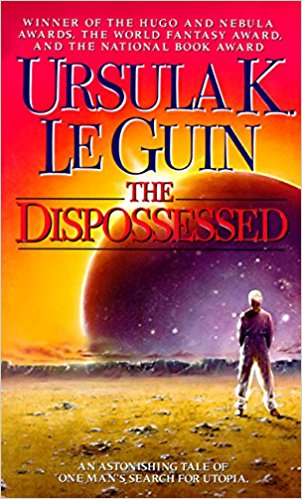
Book Review: The Dispossessed, by Ursula K. Le Guin

Le Guin is one of my favorite authors (though this is partially due to the fact that I don't tend to read the breadth of many authors' works) and The Dispossessed does not disappoint.

As in most of her writings, Le Guin's story is an exploration of society: what makes up a society, how people act within society, and how those actors work together to maintain and change the societies they live in. In The Dispossessed, she explores the dynamics of an imagined anarchic society on the planet Anarres and contrasts it with those of a capitalist society on the neighboring planet Urras. And I do mean neighboring; for most of Urras's history, Anarres was an uninhabited moon. The anarchic society on Anarres was founded by revolutionaries from Urras about a century and a half before the beginning of The Dispossessed.

I should take a moment here to clarify: when The Dispossessed speaks of 'anarchy,' it does not mean the colloquial usage as a synonym for chaos. It is a true anarchy. There is no government. There are no laws or property rights. Only people, all working together to do what is necessary to support each other. However, it is an anarchy uniquely dependent on technology. A computer names each person born randomly, and oversees, in a limited capacity, the basic needs of the society--what work is needed where, etc. It is a practical anarchy, designed by its founders to persist, not just an abstract ideal.

The story follows the physicist Shevek, jumping between his past growing up on Anarres and the present where he ventures to Urras in an attempt to collaborate with the physicists there. He is also making this journey as an attempt at revolution--he believes his own society has stagnated. The first elements of a real government are beginning to emerge, and he seeks a way to reinvigorate the revolutionary spirit that first motivated the settlers of Anarres.

The details of the resulting plot are not quite important. Everything in the book functions to explore the societies of Anarres. The societies on Anarres and Urras are shown through our character's experience. We are not given a list of traits, instead we experience them as they arise in Shevek's story. When Shevek arrives on Urras, he is disgusted by the lavish patriarchy he finds there. There is no subtly here. Le Guin's anarchy is no Utopia--resources are scares on Anarres, and hard times bring suffering to everyone equally--but the scathing resentment of the capitalism on Urras is hard to miss. The (literal) climax of Shevek's story is a drunken rant against everything he has witnessed on Urras. The real value of a society is its people, he states, not its luxuries.

This book is worth reading for its ideas alone, but if you have read any other of Le Guin's works, you might notice a few interesting parallels. The first book I ever read of her's was The Left Hand of Darkness, the second was Malafrena. Both, as in this book, are about fictional societies undergoing strife/upheaval. Both do a great deal of world building through the experiences of their characters. And, interestingly, The Dispossessed is somewhat of an overlap of the themes explored in both. LHD is more concerned with society overall, while Malafrena was more focused on its impacts on individuals. The Dispossessed tackles both, but as a result I feel it has less of an impact overall. It does not help that it ends rather ambiguously--Shevek is on his way home, but we cut away before he lands again. We have only the hope of change, the idea that maybe things will get better, but no clear picture of how.

Ursula Le Guin died on January 22 of this year (2018). Though she won many awards, I believe she was still seriously under-recognized for the quality of her work. She has been a huge influence on my own writings, and I believe that if you are reading science fiction and haven't yet read Le Guin, you are doing it wrong.

The Dispossessed, and many other of Le Guin's works, are available wherever books are sold.

Sunday, July 22, 2018

Book Review: An Excess Male, by Maggie Shen King

This is one of the best book I've read.

Set in a near-future China, An Excess Male follows the story of Wei-Guo as he tries to marry into the family of Mei-ling as her third husband. Extrapolating from the present-day consequences of China's one-child policy, Maggie Shen King envisions a dystopia where an excess of males (over 40 million) in the population has lead to women taking second and now third husbands. These unmarriageable men are known as 'The Bounty,' and most of their lives are centered around raising money for a dowry and hoping they are lucky enough to impressive the right woman.

We begin the story by watching Wei-Guo try to woo Mei-ling by inviting her to a private meeting at his exercise studio (he works as a physical trainer, helping those of The Bounty fulfill their state-mandated fitness regiment). However, the moment Mei-ling stumbles in carrying her hyperactive toddler his plans fall to pieces. Her first husband, Hann, joins them soon after, and what Wei-Guo envisioned as a seductive date turns into an awkward dance lesson between the four of them. It is here that we begin to realize that he is not marrying Mei-ling, but her family, a point reiterated throughout the book. We quickly learn more about Mei-ling and Hann and his brother, Xiong-xin (or XX, as he prefers to call himself), and the story develops into an intensely personal examination of oppression, cultural values, and the ways in which people's lives are shaped by the society around them.

Hann is gay or, as the government puts it, 'Willfully Sterile,' a fact he has done his best to keep hidden from all those outside of his family. His brother, XX, is somewhere on the autism spectrum, and though he is a genius working for one of the most important digital security corporations in China, his quirks constantly threaten to out him as abnormal. Hann, also a very successful man, has spent most of his life trying to protect himself and his brother, and he has spent the majority of his marriage trying to convince Mei-ling that his homosexuality is not a choice. Mei-ling, for her part, loves Hann and their child, but has grown to resent XX, and sees Wei-Guo as a potential outlet for her sexual frustration. She spends her time taking care of their one child (she is expected to sleep with each of her husbands once a week until she conceives one child for each, but has only conceived with Hann). If either of her husband's 'conditions' are discovered, the family risks dissolution, forced sterilization, and the loss of their child to the state.

The resulting drama and peril covers a wide breadth of thought-provoking themes: oppression, family, gender relationships, sex and love--but what drives everything is the characters. We cycle through each of their perspectives as the novel progresses, seeing how each of them thinks and perceives the world. The writing makes each of their personalities shine through. Each unique voice garners sympathy and understanding. Several times through the book one character makes a decision that proves detrimental to one or more of the others, yet at no point does anyone become a villain. We root for all our characters, even when they are directly opposed to the others. The novel is presented as the story of Wei-Guo, but he is no more the protagonist than any of the other three. This is the story of an ensemble; a family.

Family is the most prominent element in the work. It is the central tension between all our characters: Mei-ling struggles to accept her family, Hann struggles to keep his family together, XX struggles to find his place in its structure, all while Wei-Guo tries to become a part of the whole big mess. The imagery, symbolism, and more often than not the literal text are all focused around how and why people make up families. Our characters become deeply entangled with each other's lives long before marriage becomes a reality, and we realize family goes beyond living under the same roof or a contract under the law; it is what we make of it, and what we need to survive.

Of all the books I've read this year, this was the best. It was moving; exciting; and tragic. I empathized with these characters more than any others I can think of. I have not said much about the world or the plot because so much of it is revealed through our character's eyes, and their interpretations and decisions drive the story forward. It is enough to say that King's dystopia is fascinating, horrifying, gripping, and all too plausible.

An Excess Male is available on Amazon in print, ebook, and audio formats and wherever books are sold. Read it.

Popular Posts