Sunday, March 25, 2018

Book Review: Ringworld, by Larry Niven

A deserved classic and a damn fine book.

If you want a good lesson in pacing look no further than Ringworld. It hits the ground running and does not let up until the very last page, yet it is never rushed, and the brisk pace makes the slower moments even more impactful. Not a word is wasted here; the book takes all of two and a half pages for the plot to kick into high gear when the veteran space pilot Louis Wu is accosted by an alien named Nessus who invites him to join him on a mysterious mission in an uncharted region of the galaxy. Nessus is one of a species known as Pierson's puppeteers, a race known for their utter devotion to caution, and he is the first puppeteer to appear on Earth in over 200 years. Driven by curiosity, Louis agrees to be the mission's pilot, and soon after we meet Speaker-To-Animals, one of the war-loving kzin species who is hired to be the group's muscle. The final member of their crew is Louis' lover Teela Brown, a young girl who is selected by Nessus for her incredible luck (more on that later).

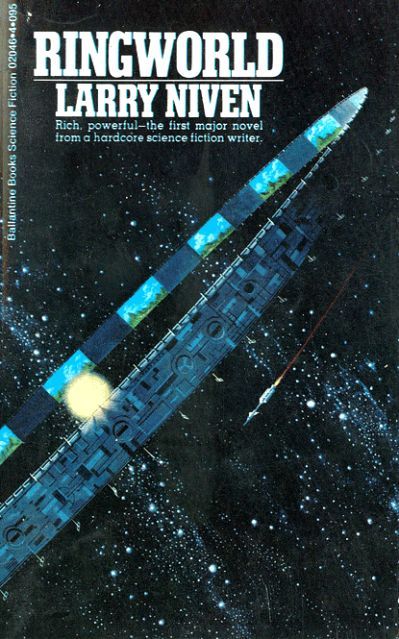
Louis and his crew discover and crash land on the titular Ringworld (it's exactly what it sounds like; see cover), and then must explore the vast landscape around them in order to repair their ship and find some way to escape. The story is an adventure, but the majority of the plot is driven by the characters and their reactions to the environment around them.

Entwined with its excellent pacing is a good sense of character building. At first the aliens of Louis' crew are rather archetypal: the kzin is a proud warrior from a proud warrior race and jumps to violence at the drop of needle; and Nessus is cautious to a fault, just like every other person from his species. It would be easy to write such alines as one-note cutouts of their respective races, but instead Larry Niven uses this foundation to build complex characters that both subvert their archetype and fufill it to its logical extreme. For example, the bloodthirsty kzin have historically warred with humanity to the point of near-extinction, and are now peaceable enough to send ambassadors and establish treaties with other civilizations, while the puppeteers, though considered weak cowards, have practiced caution and safety to such an extreme that their technology is vastly superior to any other species in the galaxy (except the builders of the ringword, hence why they want Louis to investigate it). There are more individual examples as the story progresses, for we see that each character has a much greater depths than the stereotype of their species would suggest. The kzin Speaker proves himself to be the most reasonable of the group in many cases, while Nessus's is revealed to be 'mad' for his species, as no one else would have dared to go on such a mission in the first place.

As with all good science fiction, the characters are vessels for ideas, but they are characters first, and though many scientific concepts are discussed such conversations are always logical consequences of the story--there are no random lectures or tangents. Even the most technical aspects of the book are character-driven, as who is presenting an idea is just as important to a scene as the idea itself. We are right with our cast as they try to reason out the wonders they encounter.

The ringworld is vast and mysterious, but perhaps the most interesting part of the narrative is the character of Teela Brown. On a surface level, her character is underwritten and, as the only female character in the book, unfortunately flat. Louis laments that she is too naive to really know what she is signing up for (she has never been 'hurt' as he puts it), and he does his best to dissuade her from joining him on Nessus' mission. There were several scenes early on where I feared she might end up as just a trophy for Louis but by the end of the book all of these aspects feel like intentional choices. Her character seems to be the central idea. Teela might lack any agency whatsoever, or her choices and desires might be the sole reason anything happens in the book at all.

As stated earlier, Teela was selected by Nessus for her "luck." In the future of Ringworld, aging has been halted almost completely (Louis Wu is around 200 years old), and as a consequence the Earth has become incredibly overpopulated. Only winners of a lottery system are allowed to have children, and Teela is the descendant of several generations of consecutive lottery winners (she is only 20). Teela, Nessus reasons, has been genetically selected for luck by the evolutionary pressure of the lottery system--only people who are lucky will get selected, so only lucky people will pass on their genes, so their offspring will have those "luck" genes, and then only the luckiest of the next generation will pass on their luckier genes, etc.--and so if she accompanies them, she will ensure they will not encounter any trouble. She is their "good luck charm."

Louis, at first, finds the idea ridiculous, and after their ship crashes both he and Nessus abandon the notion that luck can be selected for through evolution. But then Louis keeps pondering the idea. He had complained that Teela had never been hurt, either emotionally or physically, and he was envious of her innocence before they left Earth. This would be very lucky, he knows. Soon the idea works its way back into his mind, and as Teela survives more and more perilous situations he becomes convinced that she is indeed the luckiest person alive. Teela's character, we come to realize, is an exploration of luck as a physical concept--and it is taken to its logical extreme. I will not go into the details, as that is part of the fun of the book, but suffice it to say that 'being lucky' does not mean the same as 'being safe.' Her luck drives her to become a more complete person, and by the end of the novel Teela chooses to stay and explore the ringworld on her own.

I don't have too much more to say without turning this into a full-blown analysis (and I don't really have the patience to build something like that right now), but I have a few closing comments. There is a good deal of humor here, all arising from the interplay of Louis Wu's motley crew, and enough worldbuilding to make the world feel real while leaving you wanting more.

A few elements could be construed as problematic, but they are minor blemishes. There are a few racist word choices that jump out as simply dated and unnecessary, but they are only one-off bad descriptors. There are no insidious ideas or degrading situations like those in Stranger in a Strange Land, and even if you read Teela Brown as more of an idea than a character, there is at least a lot of nuance and intrigue in the discussion to be had around her.

Overall, a very good book, and an easy read. If you enjoy science fiction, definitely pick it up.

Ringworld is available on Amazon in print, ebook, and audiobook formats, and wherever books are sold.

Monday, March 19, 2018

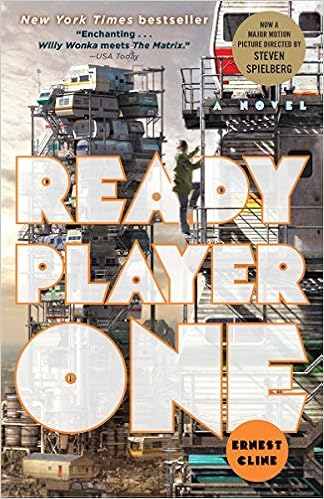
Book Review: Ready Player One, by Ernest Cline

 Ready Player One is, far and away, the worst book I have ever read. It fails on all fronts: it has no sense of character, no control of tone, bland prose; the world it builds is unimaginative and derivative, the plot is almost non-existent, and the few good ideas it might have had are buried far below the utter garbage heap that is this novel.

I'm sure most of what I say here will have been said before. The film adaption of RP1 is slated to come out at the end of this month, and its critics have only gotten more numerous as the wider culture has become aware of the original novel. I am here only to confirm their findings--every bad thing you have heard about this book is true, and it is more embarrassing and boring to read through than you might imagine.

Originally, I did not intent to read RP1 at all. I have a plethora of other books I want to get through, and I'd heard enough about it to know I wasn't interested. However, I took a long car trip with a few coworkers recently, and their choice of audiobook turned out to be Ready Player One. The experience, at the very least, gave me something to do as I watched the scenery pass us by, and I tried to digest everything I was hearing.

For those who do not know, Ready Player One is a science fiction novel whose main gimmick is that it is full of pop-cultural references; to the point where it is almost nothing but pop-culture references. We follow an 18-year-old boy named Wade Watts, who lives in a dystopian future where most day-to-day activities take place in a virtual-reality video game called 'The OASIS.' Education, business, and vocation all take place in The OASIS, which is a dream-like paradise that serves as the only escape Wade has from the dreary reality around him. The plot starts when the OASIS's creator, a billionaire by the name of James Halliday, dies, willing his fortune and control of the OASIS to the first person who can find the 'Easter egg' he has hidden somewhere deep in the game world. He leaves behind a series of clues and challenges for the inhabitants of the OASIS, and it is this trail that Wade must follow in order to achieve fame and fortune.

The execution of the resulting story is a series of slow, meandering scenes that consist mostly of Wade reciting lists of all the pop-culture he has consumed in order to get into Halliday's mind and decipher his various riddles. It is the most uninteresting use of reference possible. Instead of merely alluding to certain movies or games or songs, etc., or incorporating them into cleaver puzzles or diving into the reasons for why Wade and Halliday are so invested in the art they love, the author, Ernest Cline, plays a one-player game of trivia-night. The challenges Wade faces are mostly video games within the OASIS--two degrees too far removed from reality for any real stakes to emerge--and the 'riddles' he must solve are so specific and obscure that the reader has no chance of guessing their solution. This removes any tension or payoff from the mysteries that surround each step in Wade's journey.

The most egregious example is Wade's conquest of the first of three 'gates' on Halliday's quest. Wade finds himself in a simulation of the movie War Games, in the place of its main character, and to complete this stage of the quest he must simply... recite each line of dialogue in the movie. He happens to have it memorized, because he knew Halliday was a huge fan of it, and so he is able to pass. There is no tension in this situation. No stakes if he loses (he can just try again). Watching Wade recite War Games is less interesting than reading its Wikipedia article. In that situation, at least, I might learn some interesting factoid about the film. As presented, it is simply Cline's statement that "I saw this movie you guys. Look at how I was able to remember this movie I've seen a few times and can also google." It is a baffling, agonizing scene--but so are most of the others in this book.

The reason for all this focus on banal minutia is, we are told, because Halliday was a huge fan of 80s and 90s pop-culture, and so designed his quests around references to the things he loved from his childhood. He wants for everyone to love those things as well, and used his fortune as incentive to force those desperate for an easy life to memorize and consume all of the media he was fond of. The world Halliday inhabits is repeatedly described as a miserable dystopia, but not once is it brought up that the man's fortune might have been better spent on improving the lives of others. Sure, he offers some free education to the masses, but it is in the OASIS, and he is never shown to be consciences of how his power might better humanity or alleviate the world's woes. Instead he locks it all away, dangling a carrot in front of his loyal players so they might think and love exactly like he does.

There is a disgustingly objectivist undertone to Halliday's character, but I have neither the time, experience, nor desire to dissect it completely. What I do wish to talk about, and what perhaps hasn't been too thoroughly eviscerated, is the design of the OASIS itself.

You would think that, at the very least, Ernest Cline might have a few good ideas about video games, judging by how many he has played (or at least heard of), but no. The OASIS is perhaps just as boring a video game as RP1 is a book. It is ostensibly an MMORPG, but for all intents and purposes it doesn't seem to be about anything. There are generic fantasy classes (wizards, knights, etc.), but there is hardly any setting beyond those details. The worlds we visit are all either generic (there is a school planet with nothing but schools) or made of references (there is a Star Wars planet/sector, a Firefly sector, etc.). Many of the worlds, we are told, were programmed not by the OASIS developers, but by third-parties who wanted to put them into the game. OASIS, as far as I can tell, seems to be closer to Garry'sMod with a class system than anything else. Which is fine, but we are given no reason why this particular freeware sandbox came to so thoroughly dominate the world, and there are several design choices that make this situation even more unbelievable.

For one, you have to expend in-game currency (which is the same as real-world currency, apparently) to use the 'teleporters' that instantly transmit you from one world to the next. Otherwise you must take some form of in-game transportation to get where you want to go, limited, of course, by a maximum speed and the size of the OASIS universe. This is garbage and nonsensical game design. Why is fast-travel paygated? Why is there a travel time between worlds? That would be like having to wait an hour to load up Facebook because you live an hour away from where its servers are hosted. That's not how that works in real life. That's not how load times work. What kind of idiot designs a video game like that? What kind of idiots pay money to use that system? What moronic world makes it the most popular video game in history, so much so that it replaces the Internet and the real economy?

The fact that the OASIS is a video game and a VR sim has some impact within the narrative, but there is so little detail offered about what exactly it is supposed to be that it might as well be anything. There is no gameplay loop, no evidence of world-building within the OASIS, no detail about what the differences between character classes actually are, and no structure to inform what is and isn't possible. We are given nothing but a few arbitrary rules, and new ones are introduced on the fly as they become convenient for the plot. Things just happen because they can, apparently. But in a world of endless possibilities, why can't Wade simply wish away his problems? Why does everyone have to play by the OASIS's rules? Why haven't people scoured through the OASIS's source code? Why can some people hack their VR systems to control multiple people, but not just no-clip through the floor and grab Halliday's Easter-egg without worrying about his inane riddles? Nothing in or out of the game makes sense--even the tern 'Easter-egg' is misused. If, as Halliday does, you announce to the world that you hid something in your game, and then make it a public quest with global learderboards, then it's not a hidden secret. It's just a normal quest with a huge reward. Cline fails in the one basic thing he set out to do when he can't even get his nerd terminology right.

The more I type the more I want to say, but I have already given this book more attention than it deserves, so let me get back on track.

Cline, when not wasting paragraphs listing off the names of each anime, video game, song, and movie he has even heard of, used Wade's story to go on embarrassing tirades about god, or masturbation, or whatever else he wanted to blog about on that day. When he finally returns from these tangents to try and advance the plot, he describes his scenes in long-winded, pointless prose that adds nothing but more lists of references or redundant detail. Too often the references are made and then described, such as when the oragami unicorn from Blade Runner appears as one of Halliday's clues; and then the next paragraph or so is spent informing the audience what Blade Runner is--but only what it is. There is no engagement with the media here, we do not get insight into what Blade Runner means to Wade, only that he has seen it, and that it is 'very cool' or 'awesome' or whatever. The references are barely an aesthetic; no deeper meaning is generated by incorporating them.

At times the writing is downright insulting. Not once, but two separate times, the world 'unique' is used, and then Wade proceeds to tell us what 'unique' means. I do not have the exact quote on me, but it was to the effect of: "[Each username in the OASIS was unique, which meant that no two people could have the same name.]" YES ERNEST, THAT IS LITERALLY WHAT UNIQUE MEANS. GOOD JOB. Again, he does this twice, with almost exactly the same phrasing both times. I could not believe my ears.

I haven't even touched on all the problematic elements of the work. Wade is a creep toward a fellow female player named Art3mis, and is then rewarded for his stalker-ish behavior in the end when he gets the girl. It's not as blatant as the misogyny in Stranger in a Strange Land, but it's still pretty uncomfortable. (Incidentally, if you really want insight into what Ernest thinks of women, check out his infamous poem: 'Nerd Porn Auteur'). There's also some LiteRacism in the characters of Diato and Shoto, two Japanese teenagers whose character traits consist of Samurai gear and more talk of 'honor' than Prince Zuko could stomach. There's a lot to unpack in that, but I really don't care to do it. It's not even worth the effort.

There is one thing that almost works, one moment of genuine humanity drowned in this mechanical regurgitation of the last 20 years of western nerd media consumption. Wade's relationship with a virtual friend, known only as 'H,' almost works. Specifically the reveal that H is not, in fact, the dudebro he acts like, but a chubby black girl estranged from her mother because of her sexuality. Wade realizes in the moment he meets her that she is still the same person. Her personhood is shown to transcend her labels, and his brief feeling of betrayal is washed away into relief as he realizes that all the time he spent with H in VR had genuine meaning. It is a legitimately sweet moment, but their relationship is given little focus in comparison to the rest of the narrative. There are no other thematic tie-ins to the ideas touched upon in that scene, no overarching statement about the human condition or a reflection on the consequences of the interplay between the interconnectedness and anonymity brought on by technology. Instead we are quickly sent back to lists and the one-sided, immature romance between Wade and Art3mis. The moment is an aberration; a broken clock glanced at the right time of day.

Ready Player One is available on Amazon in a variety of formats. Its film adaption, directed by Steven Spielberg, will be in theaters March 29th. Please don't go see it.


Sunday, March 18, 2018

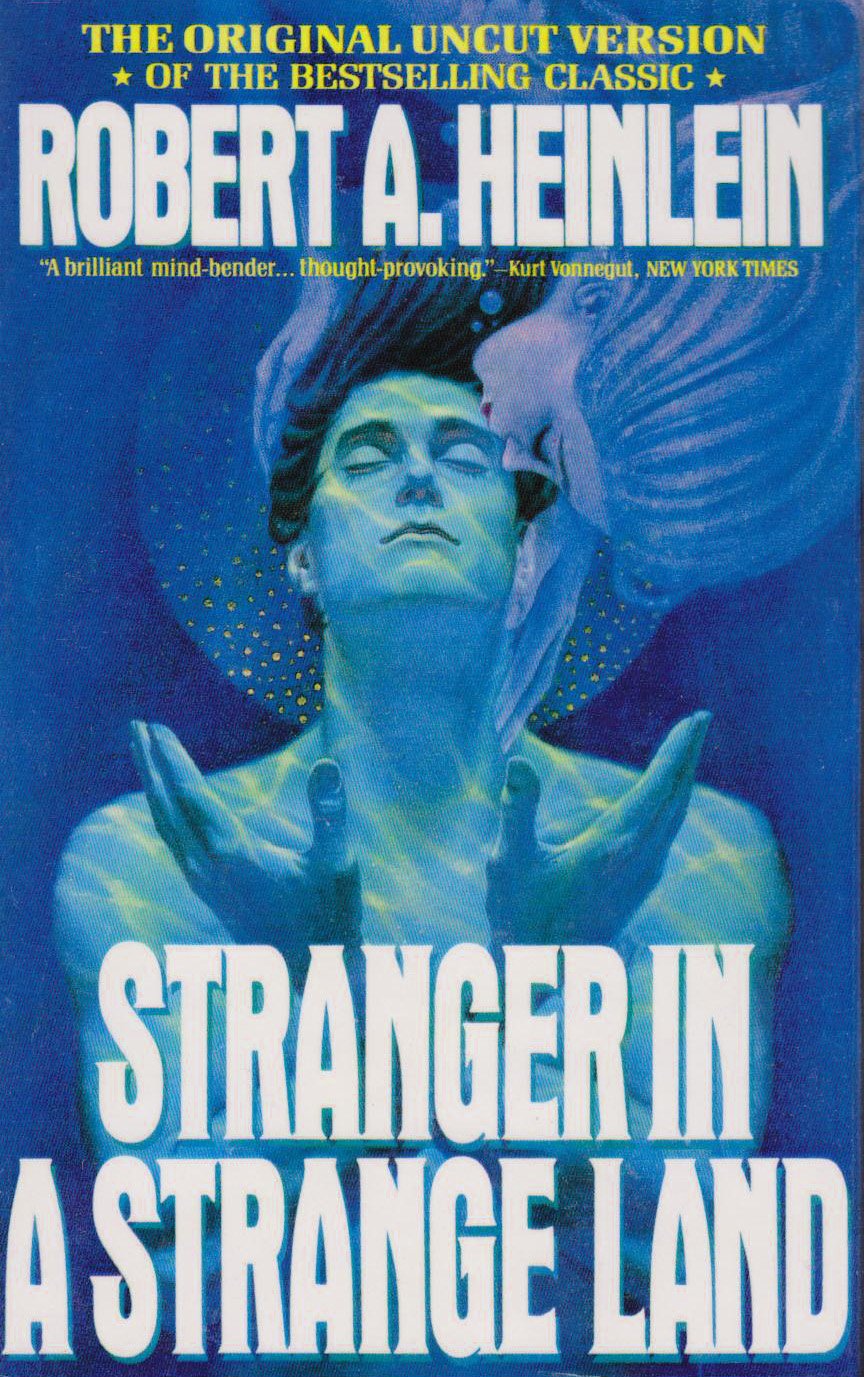
Book Review: Stranger in a Strange Land, by Robert Heinlein

I read Stranger in a Strange Land almost six months ago, and have since sold my copy for store credit. As such, I was not planning on writing up a review for it, but I keep wanting to make comparisons to it in the books I am currently reading, and I figured it was worth having my opinion on hand for the times I might refer to it.

It is a disappointing slog.

The prose is strong--Heinlein knows how to write sentences and paragraphs, unlike another I will soon be writing about--but all interesting aspects of the story, world, and characters are forgotten in favor of gross, meandering philosophizing.

The plot, at first, is about Valentine Michael Smith. He was born during humanity's first expedition to Mars and was subsequently raised by martians. Valentine is sent back to Earth as an envoy of the ultra-advanced martians, who view Earth as little more than an uncivilized curiosity. With him he brings their culture, the word grok, and a child-like innocence that leads to awe at all he sees. He also has godlike powers; but we will return to those aspects later.

The story is interesting at first, and there is a refreshing realism in how Valentine's return to humanity is handled. The biggest worry concerning this 'man from Mars' is, of course, who has jurisdiction over him and the fortune his Earth-born parents have left him. He is blissfully unaware of the legal battles taking place around him, and spends his time in a hospital bed, tended by nurses who are struggling to learn about his alien physiology. We follow the perspective of one of these nurses, Gillian Boardman, as she begins to befriend Valentine. She is aware of the multitude of governments conspiring to gain custody of Valentine and his fortune, and realizes he is powerless to stop them, as he does not even understand the concept of property, let alone eminent domain or inheritance. She breaks him out of the hospital, and, through the help of a former lover, finds refuge for the two of them in the house of a former lawyer: Jubal Harshaw.

Jubal is perhaps this books biggest problem.

He comes off as, for lack of a better term, a self-insert. He is a famous author, has many different degrees from prestigious universities, and was also a physician at some point before he retired. He lives in a private mansion with three young female secretaries who wait on him hand and foot (but there's no sex stuff, so it's not weird, right?). As soon as he is introduced he dominates the narrative. Gillian becomes just another woman in his house as he singled-handedly protects Valentine from the government who wants to exploit him and makes a buffoon out of anyone who tries to challenge him on any front. He is almost foiled by a few over-eager police officers, but Michael has the power to 'discorporate' any person or thing he views as a threat. This is given the explanation that he can move things with his mind into the fourth spacial dimension (which is immediately fatal because it is empty), but this amounts to little more than technobabble, as nothing more is done with the idea of higher dimensions. Thus Jubal's invincibility is assured, and we are forced to spend more than half of the novel's pages listening to him babble about whatever Heinlein decided he wanted to talk about the day he sat down to push out another few paragraphs.

Jubal's introduction does not immediately sink the narrative. At first his political maneuverings are used to affect good world-building; the government seems to be tipping toward a fascist state; fortunes are told by a type of mathematical astrology; the major religion is a strange mix of Christianity, college parties, and a suicide cult. However, as we spend more time with him, his shtick quickly grows old, and any development of Gillian or Valentine is pushed aside in favor of The Jubal Show.

We do eventually get back on track. Gillian and Valentine elope to perform in a circus for a while, and attempt to do some soul-searching after Valentine discovers religion and tries to grok it (more on that word later). He eventually starts a free-love sex-cult, and convinces his friends to join him and learn to grok together. His new religion spreads, and soon he is confronted by an angry mob of the dominant religion. He stands before them and they attack, pelting him with whatever is on hand until he is dead. His spirit becomes a martian 'Old One' that can still interact and speak to his followers, and he encourages a grief-stricken Jubal to keep living before ascending to heaven and becoming an angel (Yes, it is explicitly the Abrahamic heaven. His name is Michael, after all). His friends, in martian tradition, eat of his flesh (just like Jesus--DO YOU GET IT?) and it is there the book ends.

If it were only that Jubal were boring, maybe this latter part could redeem it. It seems dramatic enough, as I have described it. But any hope of genuine investment is extirpated as Heinlein's drivel descends into outright misogyny. At the start, it seems only like the unconscious trappings of the time he lived in (it was written in 1961): female characters are called by pet names and 'girl' in casual conversation, etc. But once we return to Valentine and Gillian's tale things worsen.

First, female exhibitionism is equated to male voyeurism. Gillian, at one point in her circus career, finds herself dancing in front of a group of men. I don't think it was an actual strip-tease, but she was scantly clad. Valentine, using his plethora of powers, lets Gillian see and feel through the eyes of one of her onlookers. She thinks about what she is seeing, and realizes that her experience performing for this man gives her the same excitement that he experiences while watching her. The sentiment is generalized, and Gillian is returned to her body, more willing to continue her performance. It is gross and insidious, but any attempt at justifying such sexism is dropped as Gillian comments to Valentine that "9 times out of 10 when a woman gets raped it's partly her own fault" with little prompting, reason, or follow-up.

That is the peak of the depravity, but such bile would not be as distasteful without a few notes of homophobia and racism. The religion that Valentine creates is based upon free-love, and the female characters are all too eager to sleep with many a man, but not once is it touched upon that f/f or m/m interactions might occur in this place where everyone's walking around naked 24/7. It is mention in passing only once, and quickly dismissed when Jubal says something to the effect of "good thing no-one here's a queer, haha, otherwise I'd feel weird being naked next to you, dude." I don't want to bother looking up the exact quote.

Oh, also, the affectionate nickname Jubal gives his one Muslim friend is 'Stinky,' and though I don't know for sure if that's a racial slur or not, it sure as hell reads like one.

The word grok is used throughout the book, presented as a mysterious martian concept, it is used by Michael instead of the word 'understand'. There is an implication that grok is something different; something more. But the point is overemphasized. Grok is only understanding; maybe it is a more empathetic understanding, or a deeper, introspective understanding, but it is used as a synonym to that word, and so we are left only with its mundane translation. There is no point made about language or alien empathy; only the eating of flesh, and the projection of a Christ figure onto an empty idea.

Heinlein expounds the worst ideas of his time (and ours), and it is little wonder that what promise his book showed falls apart into utter rubbish once his likeness barges his way into the story. I had to force myself to finish the last two thirds of this book, which claims to be "The most famous science fiction novel ever written." If this is still true, it speaks to the sad state of affairs of our genre. Stranger in a Strange Land makes no attempt to explore or criticize ideas, either real or of its own making. In a story that travels to Mars, we spend all out time on Earth. It does not reach beyond its own time or try to imagine a better or worse tomorrow. It is a bland, regurgitated meal, with no vision or imagination, flavored with the worse tastes imaginable.

This garbage is available at pretty much every bookstore I've been to. It's also on Amazon, just like every other book ever made. Don't buy it.

Saturday, March 10, 2018

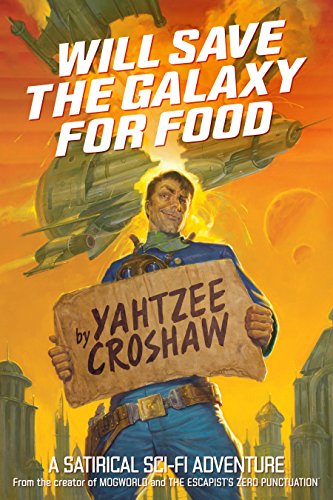
Book Review: Will Save the Galaxy for Food, by Yahtzee Croshaw

It's fine.

I am still new to this reviewing thing, and I am not quite sure how much I want to talk about a given work as an isolated entity vs. talking about it in the context of its creation and author.  For this book, however, the only reason I bought it in the first place was because I was familiar with its creator: "Yahtzee" Croshaw (real name Ben), and so I will probably talk about him as much as I talk about his book.

For those who don't know, Yahtzee is a content creator on YouTube--a fairly popular video game critic known for his sarcastic and rapid-fire review style. His show is comedic in nature, but Yahtzee does not stray from moments of genuine vitriol or adoration. His book tries to be much the same, in a broad sense, but the same pacing that keeps an internet audience watching does not quite translate to a compelling narrative, sardonic as it may be.

Overall, the novel is fine. If you are familiar with Yahtzee's style of humor, then you will probably know about what to expect from his book. His usual trend of using shocking metaphors/similes is toned down (which is probably for the better; they are much more hit-and-miss in print, without the aid of his delivery), and he has a good control of prose and a strong voice for his central protagonist. However, the supporting cast is rather one-note, and this hurts the novel in more than one way. The humor here is situational, but the situations our cast finds themselves in are rarely driven by characters or their choices in the narrative, and so the result is a disconnect montage of perilous chases and wacky hi-jinks. If this were a movie, it would be enjoyable to sit through, but a book demands more focus from its readers, and though Yahtzee is capable of crafting entertaining scenes and situations the narrative is rarely ever compelling. I took almost as long to read through this book as I did The Race (which it is about double WStGfF's length) simply because it was lowest on my list of things to do while waiting at the laundromat.

Our unnamed protagonist (who I shall call 'X') is a space pilot in an era that has invented interstellar teleportation. He uses his obsolete skills to eek out a living taking tourists on sight-seeing tours of alien planets and recounting his adventures from days long gone. The plot of Will Save the Galaxy for Food begins when X finds himself unwillingly in the employment of a powerful mobster, pretending to be the  Earth-famous author Jacques McKeown. Jacques, our protagonist informs us, is infamous among star pilots for ripping off the adventures of other pilots and publishing them as his own works. The woman responsible for his predicament, the mobster's secretary Ms. Warden, hired him under false pretenses, and the two are forced into an antagonistic partnership as she and X both turn on the mobster and attempt to flee into the lawless frontier of deep space.

Ms. Warden is a cold, embittered genius with little street-savvy, and most of the banter in the book comes from her interactions with X and his frustration with her as she propels him into increasingly worse scenarios. It works, but it is all played for laughs for the most part and we do not get a strong enough sense of who these people are to really care about their adventures. We are in X's head, but aside from a few mentions of 'the good old days' and his pride in being a star pilot, we do not get a real reflection on what those days were or any feeling for what he has lost with the advent of teleportation. Our character's backstory is left mostly blank, much like the world building. The world is ur-sci-fi. We get some description of the relevant political maps, history, and technobabble, but by and large we are meant to see these words and fill in the blanks with the generic, Star Wars/Star Trek iconography. This is not a slight against the book; it is acceptable shorthand where setting is not important, such as in this sort of action-comedy, but it falls short of generating real interest in what might be around the next corner. It's like finding a stray penny. You'll pick it up, but you won't scuttle around on the ground to look for more.

Either one of those factors would not cripple a book, but the lack of character depth coupled with a generic world leaves little else to keep pushing the reader forward. The secondary characters are, as I mentioned, all one-note. They get arcs, in a sense, but it is little more than advertising their character quirk until it is given a basic subversion or fulfillment in their final scene. There is very little growth, and in the end things return more or less to the status quo. X and Ms. Warden do have some actual development, but their relationship is fairly static until the last third of the story, and in the end they go their separate ways and settle into a distant sort of friendship.

Again, it's not that any part of this book is bad--there is maybe one or two questionable jokes, but they are only throw-away lines--just that it is not compelling. I know Yahtzee has written a few other books, and if anything reading this has made me more curious to see if he has produced something more serious. He is a decent writer, and a greater focus on character would go a long way toward a better read.

In sum, it's a fine book, but I would have a hard time recommending to anyone. It'll get you through a plane ride or two, I guess, but I see no reason to seek it out over any other book.

Will Save the Galaxy for Food is available through Amazon in both print and ebook format, and (as I have just discovered) as an audiobook on Audible. In fact, your best bet is the audiobook. Yahtzee is the narrator, and, like I said, it would be more easily consumed in a passive medium.

Monday, February 5, 2018

Book Review: The Race, by Nina Allan

The Race is eloquent, engrossing, and a deeply personal exploration of character and one vast, almost ethereal idea.

Talking about this book is difficult; it's structure is layered, and the connections between each of its pieces is left up to some interpretation. The book is divided into four sections. In the first we follow Jenna Hoolman as she reflects on her life in the fictional British town of Sapphire, and it is from her part that The Race gets its name. Sapphire is somewhat of a tourist town, and it's main attraction is the 'smartdog' racetrack. The sport is very much like normal dog racing, but with genetically enhanced greyhounds linked telepathically to their jockeys/runners with the help of an implanted micro-chip. Jenna has a brother who works as a manager and breeder of smartdogs, while she makes a living sewing personalized racing gloves for the dog runners, which is the popular fashion.

The writing through this section, and the book as a whole, is grounded, almost anecdotal. We learn more about Jenna's brother and the town of Sapphire as she drifts from tangent to tangent, filling up the town with detailed characters and history. Yet the story never feels as if it has lost its thread. Each new detail or detour serves a purpose. It informs us of character, or shines new light on the world Jenna inhabits. It makes every location feel real, and each person feel all too human.

The plot, as advertised, kicks off when Jenna's niece is kidnapped and held for ransom. It is revealed that she was taken for her ability to form an empathetic link with smartdogs without the use of a chip--she is a natural empath. Jenna and her brother concoct a plan, fail to get the niece back, and then the section ends with Jenna adjusting to the loss and returning to her normal life in Sapphire.

The second section follows Christy Peller, a woman recounting her life growing up in Hastings, and it is here that we begin to see the layers of reality in our author's story. Christy's story has no smartdogs, or implants, or empaths, yet her life is eerily similar to Jenna's. Both women have mothers who left them at a young age, fathers who died of illness, and brothers who took over the family business. Though one can make the connection earlier, it is revealed at the end of Christy's section that she is in fact the author of Jenna's story. Sapphire is her imagined world, an escape from Hastings, and a reflection of the desires and tumult within Christy's mind. The next two sections bring similar perspective shifts, but we do not go beyond these two layers. I could go on recounting the plot, but any summary or explanation would be a disservice to the quality of writing on display.

It might seem at first that The Race is best understood as a work of meta-fiction. We are meant to understand Christy through her writings and the parallels and symbolism that she has put into her work. And we are meant to see it this way, but there is more going on. The two worlds seem to bleed into each other. People go missing, alien messages are received, legends of portals between worlds date back to antiquity. We get the sense that Christy may only be a conduit; that the juxtaposition of her story with Jenna's world implies some causal link.

This may sound abstract or lofty, but even without these connections the book would still be incredible. The prose alone is enough to pull one in and keep them listening, even if they never were to grasp the larger universe Nina Allan has presented. Each section could be published as a stand-alone short and still work, even the 'Appendix,' which makes their connections more explicit and was apparently not part of the book's first printing in 2014.

The 'meaning' of The Race is open to interpretation, yet few interpretations are contradictory. It is an exercise in world building, an exploration of magical ideas, a near-future alternate universe, a real-world story of human monsters, and episodic look at an ensemble cast; all while being a deep study of a single character, her ideas, her flaws, and her works.

If this all sounds vague it is because I am unable to talk much about the substance of the book without ruining the experience. It's structure is as much a plot point as the details within, and I am not sure if I have already said too much. Suffice it to say that, real or not, I felt a deep connection to each of these characters, and I was absorbed by their stories. Read this book.

The Race is available for purchase from Titan Books. Nina Allan blogs at http://www.ninaallan.co.uk/

Tuesday, January 23, 2018

Book Review: Autonomous, by Annalee Newitz

Autonomous, in brief, is surprisingly boring.

The book follows two characters, each on opposing sides of the law. Our protagonist, Judith "Jack" Chen, is a drug pirate living in a dystopian future where slavery is legal worldwide and patent law has given Big Pharma a stranglehold on the medical industry. Focus-enhancing and work-pleasure drugs (think Adderall or Ritalin mixed with crack) dominate the marketplace, and Jack makes her living reverse-engineering the most popular variants and selling them on the black market.

Our story begins when Jack distributes a new, untested drug that makes work more pleasurable--too pleasurable, in fact. News stories arise of obsessive behavior in the region she sold her latest batch: a student who does nothing but homework all day, a man who paints and re-paints his house until he drops dead, a train conductor who endlessly re-routs his trains, trapping the passengers in an unending journey. Jack re-examines the strain, and finds that it has been purposefully designed to be hyper-addictive. She sets off to find a cure for the drug's victims, guilty that she had a hand in the arising chaos the drug is causing.

The string of manic outbreaks also attracts the attention of the International Property Coalition, a governing body that enforcers property rights and patent laws. Here we are introduced to Paladin, a newly-created military robot who is indentured to the IPC. Partnered with a more veteran human named Eliasz, the two set off to track down Jack and arrest her for her role in pirating the drugs. What follows is a narrative split between Jack's escapades as she travels across the world meeting a cast of colorful characters, and Paladin's journey of self-discovery as he begins to define his personhood through his interactions with Eliasz. In the end they meet, of course, and the fallout leaves their world a little for the better.

Though the book has an interesting setup to a basic story with much opportunity for world building, it turns into a dreary summary of two unlikable people rummaging through a world of intriguing minutia.

Jack travels from sea, to cityscape, to the desolate quiet of her hometown, her mind wandering from the road in front of her into the past and the events that transformed her from a discontent activist to a smuggler and pirate. Yet despite these glimpses into her life it is hard to find empathy for her person or sympathy for her cause. Her first act, as we are introduced to her, is to murder a thief she finds in the midst of breaking into her personal submarine, which she uses as a lab to concoct her medicines. With him is a slave boy, who Jack lets live only because she first mistakes him for a decrepit robot. She frees the boy, named Threezed, promising to give him funds to start a new life once they reach the shore. A generous gesture, however not a scene later Threezed offers to repay Jack for letting him live with a few sexual favors, an offer which she accepts with little hesitation. This scene, already made uncomfortable by the power dynamic, is excused by our author with this gross rationalization:

"Are you sure," [Jack] asked."
He bowed his head in an ambiguous gesture of obedience and consent.

Now, that is not to say that the darker side of sex and power should not be explored, but, as becomes apparent as the book goes on, Autonomous is more concert with paving over nuance than exploring the ethics of the situations it brings up. Jack and Threezed have sex. It is stated to be consensual. The matter is settled, and the book moves on. There is no irony in the quote above, and the framing of Jack's character implies we should be sympathetic to this and her later exploits. It is supposed to be titillating. This exchange alone was enough to stop me in my tracks. I suspect Jack's story might be more interesting than I make it out to be, but what sympathy I might have had for our pirate was dumped overboard with one sentence, and I waded through the rest of her story surrounded by its stench.

Thankfully, Paladin is, at first, a much more compelling character. Through him we learn how Autonomous's robots think. We learn that they are aware of their programming, but do not have control of their own minds unless they are granted "autonomy," which in this world has specific legal meaning. Humans, too, can be granted autonomy, for many people do not have "franchises" and thus cannot get by without selling themselves into indentured servitude, which is little better than real slavery. Paladin is aware of his own enslavement, but is too young to have developed many desires or thoughts outside of those which affect the tasks he is assigned to.

His story plays out as a standard police procedural. Eliasz and Paladin travel to a city, gather intel about Jack, act on it, and then travel to the next lead. The proceedings are uninteresting, there is little mystery or tension in weather or not they will eventually discover Jack, and the logical tethers that bind each clue to the next feel arbitrary and often convenient. None of that harms the book, however, for what pulls us along is not the pursuit of Jack, but Paladin's internal struggle to understand himself and the world around him.

Eliasz, we come to realize, is attracted to humanoid robots, romantically, and Paldin is stated by several others to be quite pretty. Paladin, however, was not created with any real understanding of human sexuality, and so when Eliasz asks to mount him and aim the guns installed in Paladin's chest, the robot obeys, confused by the resulting rush of exhilaration he senses in Eliasz's body, along with another bulging physical reaction. This scene, where they are alone on a shooting range, is perhaps the best one in the book. We realize the intent behind Eliasz's request long before Paladin realizes something is amiss, and though no clothes are removed the scene feels lurid and visceral. Paladin's reaction, and his attempts in subsequent chapters to process and contextualize what happened to him are the most compelling section of the book. He searches through databases, talks to his fellow robots about human desires and their own experiences, and begins to think about himself and what he might desire from himself and others.

It is quite unfortunate, then, that our author squandered such an excellent setup by twisting the narrative into a flat love story. To clarify the scene above: Eliasz, a grown military man who was in command of Paladin and has access to his programming and thought processes, used Paladin, a newly born robot with no context or knowledge to understand what was happening to him, for sexual gratification. It is analogous, in essence, to child molestation.

After Paladin realizes what Eliasz wants, he reciprocates. Later this is revealed to be part of his programming, a function he could not see or control until he was granted autonomy. Yet after he gains free will and realizes his desires were manipulated, the resolution to Paladin's ark is not revenge or acceptance or madness. Instead he decides retroactively that his behavior was consensual, and it is at this point that I realized that what I had read as an assault is supposed to be a thrilling awakening. Our author wants our blood boiling, not freezing, as Eliasz grips Paladin's pounding guns, once again ignoring any interesting nuance of the situation.

This may come off as an extreme interpretation, but the text itself tiptoes so close to making the same connections that it is baffling that Paladin's experience is treated on such a surface level. This exchange happens  post-coitus:

[Eliasz] sat up a little more, looking at [Paladin's] face. "Is there a way that bots can... have an orgasm?"
"...I am only a few months old, so my knowledge of undocumented functions is incomplete."

When we finally get a gimps into Eliasz's mind, he condemns child trafficking and forced indenture, yet the irony in that does not seem to be intentional. He says he loves Paladin, and Paladin loves him. We are given a Freudian excuse for his attraction to robots and his hangups about homosexuality (he does not admit his attraction to Paladin until after Paladin reveals the brain installed in his carapace belonged to a woman) and it all feels like an attempt to make excuses for him. It does not matter why he is attracted to robots; that was never the source of conflict. Paladin's ruminations were what drove his side of the story, but they fizzle and die the moment he reciprocates for Eliasz, leaving us with little to do but trudge through the last few chapters of detective work.

In the end Jack escapes them, faking her own death, and Eliasz elopes with Paladin to Mars, granting the robot autonomy before asking if she would like to come along (after the revelation about Paladin's brain, the robot is refereed to with female pronouns. The choice is compared to transgenderism, but besides the surface level comparison little is done with this decision). She agrees, and we end our story on a scene of Jack, laying low until the world has forgotten about her.

I have ignored most of Jack's story, because most of it is uninteresting. She thinks about past relationships, a brief stint in prison, her work with advocacy groups and the maintenance of a repository of freeware drugs that she started after her college days. Yet we do not see her character. We see what started her on the path to piracy, but nothing that brings us to the, apparently, experienced killer we meet in the beginning. We see her agonize over the suffering she has caused, yet it is hard to sympathize with her when her ineptitude is responsible and when she lacks the basic decency to refuse Threezed's sexual favors when he is still trapped with her, alone, in her private submarine in the middle of the ocean.

Threezed too is unsympathetic. We never get a look into his mind, and all his interactions with others are sarcastic or seductive. We receive his tragic backstory from the viewpoint of another character, as she recalls a flurry of sardonic blog posts that detail his experiences as a slave. It is too disconnected to feel real, and comes too late and too suddenly to have a lasting impact.

The details in this story are creative. Robots use the brains of dead human as facial-recognition software, everything is biodegradable, the nation-states of this future look nothing like our current arrangement of countries. The descriptions of technology are precise and well-realized. There were many instances while I was reading that a detail would jump out at me. "Ah-ha," I would think, "that is brilliant!" Yet the slog through the mud was not worth those few specks of gold. No character, outside of Paladin in those first few chapters, is compelling, and by the end I was hoping they would all just go away.

Jack seems aware of systemic problems, but makes no effort to effect changes in the system, while Paladin's morality is a blank slate, existing only when convenient to have drama with Eliasz. The IPC pair brutally interrogate helpless captives, shattering bones and any sympathy we might have had for their lopsided romance.

Only one character garners real sympathy, a robot named Med. She was raised by humans and has always been autonomous. We meet her about halfway through the plot, and she she ends up helping to discover a cure for the addiction caused by Jack's reverse-engineered drugs. She goes out of her way to help Jack, loses an arm while protecting another person from Paladin, and has worked all her life for the benefit of a society that objectifies and enslaves her kind. In the end she becomes head of the Free Lab and a well-respected figure within her scientific community. Unfortunately, her story is stuffed mostly at the end, and there is not nearly enough there to salvage what came before it.

I know I've just gone on for about twenty paragraphs about a story I found 'boring,' but those few moments of tone-deafness are the rare spikes in an otherwise flat narrative. The prose has little style and is too often summary: we are told, not shown, Jack's feelings and motivations, and that is while we are viewing her perspective. Other characters are even more distant, and I feel about as connected to the events in Jack's tale as I would be had I read a Wikipedia article on her life.

I would not call this a bad book, merely incompetent, or perhaps unrefined. There are nuggets of good ideas here. There are interesting premises and a few details of fantastic worldbuilding, but it is all thrown aside in favor of... well I don't know, really. I'm not sure what the point of all this was. Big Pharma bad. Capitalism evil. Robots sexy. Pirates cool. Many themes are touched upon, but the focus lies elsewhere, in uncomfortable 'romance' and an uninteresting odyssey. There is no unifying statement; no character has a revelation. Jack will return to piracy. Eliasz does not need to change his ways for Paladin to love him. Paladin gains control over her programming, and decides to stay the course it set for her.

In Autonomous we glimpse the surface of surface of a dark ocean, and are forced only to walk along the sand. We dip our toe in and balk from the cold, too scared to dive down and explore the mysteries that lie below. We turn around, ignoring the gathering storm behind us, pretending the wind does not pull upon our hair. Instead we imagine ourselves huddled in a warm blanket at home, lounging about and watching TV. We ignore the smell of salt in the air, and focus on our vision.

We do our best to shut out the unpleasant world around us, but not once does it cross our mind: why did we ever want to come here to begin with?

Autonomous is available in print and digital format. Amazon store page.

Popular Posts